
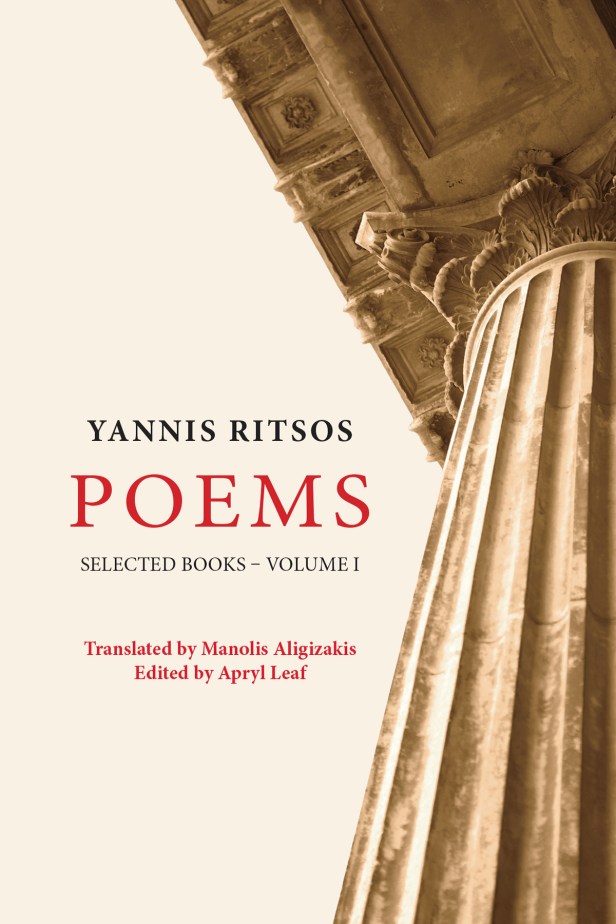
Selection, memory, and the translator’s position
The foreword locates the translation within a personal history of listening. Ritsos first enters Manolis’s account through poetry set to music, and the recollection moves outward into youthful gatherings, political identification, censorship, and the covert circulation of forbidden songs (23–24). The translator does not present himself as an invisible intermediary. He writes as someone for whom the poems were already part of communal life before they became a literary project in English. This matters because it establishes an understanding of poetry as something spoken, heard, remembered, and shared under pressure.
That understanding helps explain the translation’s attachment to direct address. The repeated brother, comrade, and listener are not incidental features to be moderated for readers who might find them unfamiliar. They belong to the social organization of the poems. A translation that converted every collective appeal into private introspection would misrepresent the experience this volume seeks to communicate. Manolis’s readiness to retain such forms of address gives the public poems a recognizable speaking situation. Readers can hear a voice attempting to establish solidarity rather than merely reporting that solidarity once existed.
The foreword is also unusually useful about the practical basis of selection. Manolis describes the Greek volumes available to him and explains the decision to translate complete books rather than detach individual poems from them (24). This account makes the edition’s breadth concrete. It also limits the claim that can properly be made for that breadth. The collection offers a substantial itinerary through Ritsos, but it is not a neutral or exhaustive miniature of the entire oeuvre. Availability and the translator’s judgment helped determine its contents. Recognizing this does not diminish the edition; it prevents the selection from being mistaken for the only possible shape of Ritsos’s career.
Whole-book presentation has particular value for the later work. A short poem that appears isolated and cryptic can become more legible when read beside others concerned with the same kinds of objects, gestures, or failures of speech. Conversely, sequence can make a familiar image less stable. A statue may seem at one moment to preserve life, at another to imprison it, and elsewhere to step out of its monumental role altogether. Readers encounter a changing practice rather than an anthology of exemplary symbols. The critical gain is not simply more poems. It is a better sense of how repetition produces difference.
The arrangement nevertheless should not be treated as a perfectly continuous chronology. The dates printed beneath the poems reveal overlapping periods of composition, particularly among the later books. Those dates sometimes complicate the impression of a straightforward progression from public confidence to private disillusionment. Manolis explains that Ritsos retained original composition dates even after subsequent revision (25). The dates therefore document an initial occasion rather than necessarily the final state of the text. Their presence encourages historically attentive reading while resisting the assumption that each poem is a transparent diary entry.
The foreword’s broad narrative of maturation and increasing disillusionment is suggestive, but the poems repeatedly exceed it. Early works already contain fear, estrangement, and failures of mutual understanding. Late works still discover companionship, sensual pleasure, laughter, and renewed participation in ordinary life. A stronger description of the collection would emphasize changing arrangements of confidence and doubt. The two remain interdependent. Assurance can be something a speaker must work to produce, while doubt can become a way of refusing the false certainties that damage human relationships.
The translator’s location in Canada supplies a further dimension. His biography records his emigration to Vancouver in 1973 and the later establishment of Libros Libertad (543). These details situate the edition within a specific act of literary circulation: Greek poetry reaches an English-language readership through the work of a Greek immigrant and an independent Canadian publisher. This does not automatically authenticate any lexical choice. It does explain why translation here appears as a continuation of cultural memory rather than a purely detached scholarly exercise. The volume carries a history of attachment into a different literary environment. An academic review should respect that attachment without reproducing the promotional claims surrounding it. The foreword’s suggestion that many selections were appearing for the first time in North American translation would require a separate bibliographical investigation before it could be endorsed (24). Likewise, the assertion of a more intimate approach than earlier translations is a statement of intention, not a demonstrated comparative result. The edition’s value can be established without either claim. Its sustained presentation of fifteen books and the effects of its English provide ample material for a substantive judgment.
(If the poetry of this great man is interesting to you, you may find more in the following links)

