
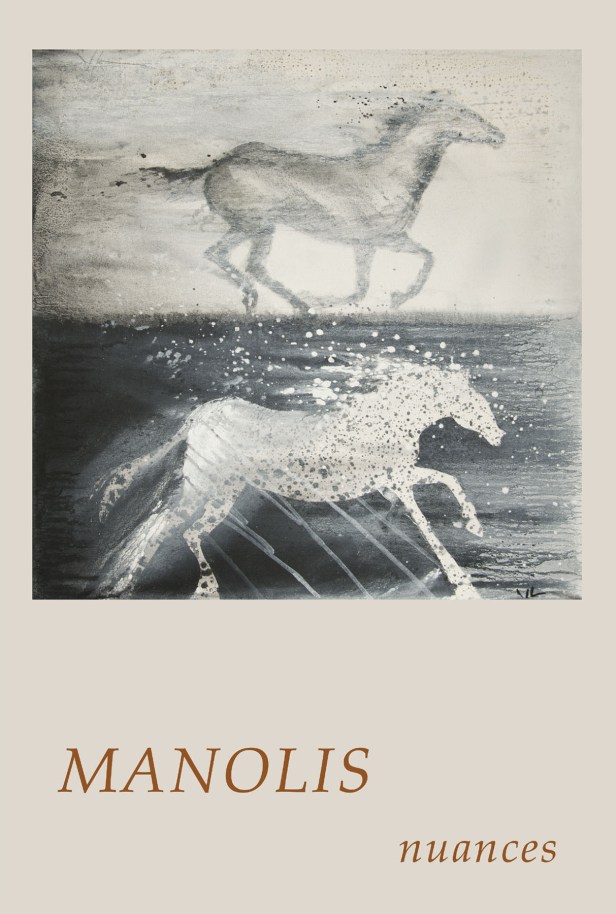
Excerpt
The book’s erotic lyrics complicate this political dimension. The poet frequently places sexuality beside religious imagery, natural beauty, and mortality. In “Whispers,” desire is rendered through tactile and rhythmic language; in “Glances,” the erotic look is both tender and injurious; in “Raindrop,” sensuality, illness, and the passage of time converge in an image of water hovering over a pond. These poems do not separate erotic experience from larger metaphysical questions. Desire is a mode of knowledge, but it is also unstable, subject to absence, jealousy, aging, and the threat of death.
The recurring presence of the Kore, Hades, Agamemnon, Clytemnestra, Orestes, Pan, Hermes, and other mythological figures gives the collection a distinctly Hellenic imaginative framework. Yet these references are not merely ornamental or nostalgic. The poet brings myth into active relation with modern social life. Hades appears not as a distant figure from antiquity but as a presence in illness, loss, loneliness, and the ordinary expectation of death. Ancient statues, church icons, cenotaphs, and sacred ceremonies are repeatedly tested against contemporary realities: shopping malls, food courts, electronic communication, political speeches, cafés, hospitals, and domestic rooms.
The inclusion of epigraphs from the Song of Songs helps clarify the collection’s fusion of sacred and erotic registers. The biblical language of bodily love does not legitimize desire through religious convention; rather, it intensifies the book’s ongoing inquiry into the holiness and vulnerability of the body. In Nuances, the sacred is not located securely within institutional religion. It may reside in a kiss, a remembered body, a flower, a sound, a compassionate gesture, or the difficult recognition of another person’s humanity.
The seven-part sequence numbered “I” through “VII” is among the collection’s most formally ambitious sections. Its typography and spacing produce a visual field in which the line is fragmented, dispersed, and rhythmically unsettled. The form enacts a consciousness moving through memory, landscape, history, sexuality, and mortality. In the first poem, roots emerge from “sacred soil,” and the self is imagined as a golden crocus rising from transparent waters. The poem’s imagery invokes ancestry and origin, but it does not settle into a simple celebration of cultural inheritance. The speaker must “decipher insignificance,” accepting both the force and the burden of forefathers and their symbols.
The sequence’s second poem develops an ecstatic present-tense lyricism. The speaker moves through meadows, rooftops, shoreline, light, and seasonal change until the poem reduces itself through repetition: “Nothing else matters / Nothing else / Nothing / No.” This reduction dramatizes the desire to inhabit a pure present, free from the weight of yesterday and tomorrow. Yet the sequence does not maintain this vision. In the third poem, the individual is absorbed into the anonymity of the agora, a mass social space figured through mechanization, consumption, digestion, and waste. The poem’s grotesque humour—its image of the individual as material processed by a celestial master—marks a sharp departure from the earlier pastoral transcendence. The result is a critique of both social conformity and the fantasy that the self can escape collective life.
The later poems in the sequence continue this oscillation. “IV” defends “opulence” against mediocrity, but its grand aspiration is undercut by its hostility toward others and its longing for vindication. “V” recognizes death as the ultimate force of dispossession. “VI” addresses loss through a mixture of tenderness, resentment, and natural imagery. “VII” brings mythic violence into relation with modern warfare: Agamemnon, Clytemnestra, Orestes, guns, grenades, roses, and gravestones occupy a shared, fractured terrain. The formal fragmentation of the sequence is therefore not decorative. It is a structural expression of a world in which beauty, historical memory, violence, and desire cannot be neatly separated.
https://www.amazon.com/dp/1897430515

